

- Disability Advocacy Methods: Carol Leish and Call Me Capable - June 15, 2026
- How To Use Capacity Building To Prevent Advocate Burnout - May 4, 2026
- Happy Activism: A Sustainable Way to Create Change Without Burnout - February 9, 2026
Last Updated on October 29, 2026
Key Takeaways
- Dolores Huerta helped build the farmworker movement and negotiate better conditions for workers.
- Her advocacy includes women’s leadership, civic engagement, and community organizing.
- Her accomplishments deserve recognition in their own right.
October 2026 update: Dolores Huerta died on October 28, 2026.
March 2026 update: On March 18, Dolores Huerta publicly disclosed sexual abuse by César Chávez during the 1960s. I stand with her and the other survivors. Her leadership and the contributions of thousands of farmworkers deserve recognition in their own right. Read her full statement and find support resources through the Dolores Huerta Foundation.
Dolores Huerta Helped Build the Farmworker Movement

Dolores Huerta was raised in California by a single mom who was active in community work. Police brutality against Mexicans and blacks was the issue that tugged at Huerta’s heart. Community organizer Fred Ross involved her in the Community Service Organization, and she was drafting legislation in her early 20s. Ross introduced her to Cesar Chávez; together they worked on organizing a farmworkers union.
Huerta was a young mother but she embraced the challenge, describing it as a calling. Her early experiences seeing police brutality and the obviously terrible conditions for farmworkers inspired her: low pay, terrible housing, lack of access to clean water and bathrooms, and long work shifts with no breaks.
Having a woman on the Board of the Union and on the picket line meant women were welcome as part of protests, and their voices could be heard. But she was also a target for holding a traditionally male position.
In 1962, Dolores Huerta and César Chávez founded the National Farm Workers Association. In 1966, it merged with the Agricultural Workers Organizing Committee, whose largely Filipino membership had launched the Delano grape strike. Together, these organizing efforts helped build the United Farm Workers.
[Inspired by their results? Get started in activism.]
She Coined a Famous Phrase
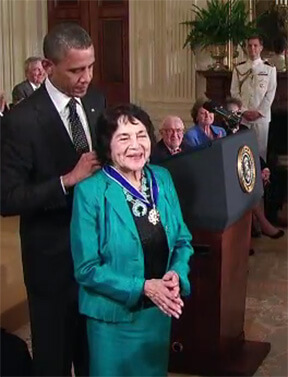
Huerta’s work goes beyond organizing the Farmworkers because, as marginalized people, their organizing inspired other marginalized communities.
When Obama used the slogan “Yes, we can,” he borrowed it from Huerta, who coined the phrase “Sí Se Puede” in Spanish years earlier. When he awarded her the Presidential Medal of Freedom, he apologized to her for not giving her proper credit.
After Chávez died, members did not elect Huerta president of the union board. She didn’t complain about it because she was more concerned about the work, and she felt the person elected president would do a good job. Eventually, though, she disagreed with the union about her goal of returning to community organizing, so she left.
Huerta’s Work Continues
Huerta created the Dolores Huerta Foundation to teach others leadership skills and community organizing.
Later in life, she says she regretted not advocating more for herself and her accomplishments and encourages women and girls to avoid that trap.
“We were having elections and Cesar [Chavez] was running the meeting, he stepped down from the dais and came up to me. He said, “Who’s going to nominate you for vice president?” And I said, “Oh, I don’t have to be on the board. I just want to serve all the women out there.” How many of us have thought that way? And he said, “You’re crazy.”
So I did — I grabbed somebody to nominate me. But if Cesar hadn’t told me to, I wouldn’t have thought about it. And I think that’s a problem with us as women — we don’t think we need to be in the power structure, that we need to be on those boards where decisions are being made. Sometimes we think well, I’m not really prepared to take that position or that role. But I say [to women out there]: Just do it like the guys do it — pretend that you know. And then you learn on the job.” – Dolores Huerta
Dolores Huerta’s accomplishments include negotiating farmworker contracts, lobbying for workers’ rights, and encouraging Latina women to seek public office. She established the Dolores Huerta Foundation in 2003. Its work includes grassroots organizing, civic engagement, education equity, and developing community leaders.
[Please share this post with a friend who wants to make a difference in the world.]
Featured Image: Tom Hilton Wikimedia Commons
READ NEXT
Dolores Peter Bratt’s documentary Dolores explores Huerta’s life, farmworker organizing, and advocacy for women’s rights. Released in 2017, it predates her March 2026 disclosure.
Browse more examples of artistic activism.
Browse more activist profiles.


As you always seem to, you’ve written about something that matters. I remember Huerta’s name from the 60s/70s but never knew much about her. Thanks.
Thanks for stopping by, Ellen! I’m inspired by her passion and persistence.