

- Disability Advocacy Methods: Carol Leish and Call Me Capable - June 15, 2026
- How To Use Capacity Building To Prevent Advocate Burnout - May 4, 2026
- Happy Activism: A Sustainable Way to Create Change Without Burnout - February 9, 2026
Last Updated on June 23, 2026
Capacity Building: Key Takeaways
- Capacity building develops skills and relationships that help prevent advocate burnout.
- Movements focusing only on mobilizing face burnout; organizing helps advocates stay engaged over time.
- Retention strengthens movements by preserving knowledge, trust, and momentum.
- Leaders can strengthen movements through connection, mentoring, and prioritizing mental health.
- Activists can contribute more effectively by asking for clarity, skill development, and community support.
In This Post
- What is capacity building?
- The difference between mobilizing and organizing
- Why capacity building is a form of activist burnout prevention
- Practical ways leaders can strengthen their movements
- How individual activists can ask for what they need to thrive
Capacity Building for Advocates
Capacity building is developing skills, leadership, relationships, and strategic understanding so advocates and activists stay engaged in a movement. Capacity-building helps turn volunteers into long-term contributors, reducing activist burnout and strengthening movement sustainability.
Activism often celebrates the visible moments, like millions of people protesting across the world. The campaign that suddenly spreads across social media. Or, an event that touches people’s hearts so strongly that donations pour in. These moments matter because they bring energy and momentum to the cause.
But if you have been involved in activism for any length of time, you have likely noticed something else. The energy fades. People who showed up once don’t come back. Volunteers who were excited drift away. That means leaders feel like they are constantly starting over. Why does this keep happening?
The Leaky Bucket Problem
One way to understand this pattern is through a concept borrowed from the business world. Organizations that focus heavily on acquisition but neglect retention suffer from the “leaky bucket problem.” Imagine a bucket with holes in the bottom. No matter how much water you pour in, the bucket never fills. Businesses that only work on attracting new customers (pouring water into the bucket) rather than keeping the ones they already have (fixing the holes) never grow.
The same dynamic shows up in activism. Movements that constantly recruit but don’t develop or motivate people who show up also have a leaky bucket.

In many social change organizations, leaders focus on sign-ups and donations. Their report cites the number of people who received the newsletter and the number who showed up at the rallies.
But here is what is often missing: how volunteers are developed and retained.
What Does Research Say?
The issue of volunteer retention is not just anecdotal. Research shows that staying engaged is harder than getting started. Participation in social change is often highest during life stages like college, where opportunities, community, and structure are built in. After that, involvement tends to decline, not simply because people get busy, but because opportunities become less visible and less accessible. Studies across volunteerism and social movements consistently find that many people disengage over time because of burnout, lack of support, and feeling ineffective.
At the same time, research on volunteer retention consistently shows that people are more likely to stay involved when they can use their strengths, see the impact of their work, and feel connected to others. Dropout is common, but it is not inevitable. And capacity building is the answer.
My Experience
Years ago, I volunteered for a dysfunctional organization. To be honest, I was ready to drop out many times, but I cared about the cause. Despite putting in many hours and a lot of effort to make things work, I came home one day and told my husband I was done. And I didn’t tell the organization. I just didn’t show up anymore. Over the next few months, a few people asked me about it, but no one made any effort to change the situation.
Looking back, what was missing was capacity building.
That kind of turnover, where people just drift off, and the organization doesn’t know why, creates a devastating impact. A first-time volunteer never comes back, or a motivated volunteer ends up leaving, taking their expertise, perspective, and motivation with them.
So if recruiting more people is not the solution, what is? To make movements work, we must strengthen the bucket.
Mobilizing vs. Organizing
This problem becomes clearer when you look at two common approaches: mobilizing and organizing. The efforts of the leaky bucket organizations are on mobilizing. Mobilizing focuses on activating large numbers of people for specific actions, like rallies, calls to legislators, and petitions.
In contrast, organizing focuses on building relationships, developing leadership, and building skills to keep people involved over time.
Both are important, and the strongest movements do both. Groups that only mobilize often have a large email list, but no community or leadership development. Movements that focus on organizing treat advocates as people who can grow into activists and leaders. And when people feel valued, they stay.
Many organizations are very good at mobilizing, but fewer prioritize helping advocates grow.
Research by Hahrie Han, author of How Organizations Develop Activists: Civic Associations and Leadership in the 21st Century, helps us understand how to engage people in activism and how to make them more effective. Her research shows that the most impactful organizations create what she calls high-engagement environments, where people build skills, deepen commitment, and begin to see themselves as capable of making change.
Why Capacity Building for Advocates Matters
Once you see this distinction, the importance of capacity building becomes much clearer. Keeping volunteers is almost always more cost-effective than attracting them. Replacing them requires time, training, and emotional energy.
But the cost of turnover is not just financial. When volunteers leave, they take their knowledge with them, and the movement loses momentum.
Capacity building for advocates strengthens movements. It is the work of developing people within the movement so they can contribute over time in meaningful ways. And this is where strategy shifts from short-term activity to long-term impact. Each campaign does more than achieve a short-term goal. It builds something that lasts.
Five Ways Leaders Can Build Capacity
Here are five ways you can build capacity for activist burnout prevention.
- Build Connection
The first way to strengthen a movement is simple but often overlooked. People may show up for the cause, but they stay for the connection. Strong movements create space for conversation, mentorship, and support that deepens the connection.
Examples of actions that support community include:
– Check in with volunteers beyond their tasks.
– Create opportunities for people to get to know each other.
– Encourage shared reflection after events.
Foster a sense of community, not just coordination. When people feel connected, they feel part of something. - Connect Tasks to Strategy
The next step builds on that connection by helping people see the bigger picture. Have you ever volunteered for something and been given a task, but you have no idea how it really makes a difference for the cause?
When volunteers understand the strategy, they move from completing tasks to engagement that leads to creativity and contribution.
– Show volunteers the broad organizational strategy.
– Help them understand why their tasks matter.
– Foster a sense of ownership by linking their efforts to the larger picture. - Offer Mentoring and Coaching
Once people feel connected and understand the strategy, the next step is helping them grow. Support the people who are giving their time and energy to the movement.
– Build real relationships with volunteers.
– Ask about their goals and motivation.
– Create opportunities for reflection and learning. - Prioritize Mental Health
As people become more engaged, it becomes essential to support their sustainability. Activism is not easy, and too many volunteers leave because of burnout. If volunteers experience urgency without recovery, exhaustion becomes inevitable and can lead to burnout. Burnout can be ingrained in the organization.
Movements that prioritize capacity building understand how to address the structural factors driving burnout in the organization.
– Support volunteers in managing their stress levels.
– Build in rest and boundaries to support mental health.
– Teach activists to understand how their bodies respond to stress and to explore potential stress-reduction strategies. - Develop Skills
Finally, capacity building becomes most visible when people are given the opportunity to grow into new roles. Helping volunteers grow doesn’t happen by accident. It happens when organizations are intentional about how they bring people in, support them, and help them stretch into new roles.
In high-engagement organizations, leaders:
– Provide meaningful roles.
– Offer training, tools, and ongoing coaching.
-Give people increasing ownership over their work.
The result? Volunteers become more confident, skilled, and invested in the cause.
Further Reading
Capacity Building and the 5-Step Activism Path
This approach aligns closely with how I think about sustainable activism. In a perfect world, both organizations and activists would be focused on motivation and effectiveness. But the activist dropout rates tell a different story.

Capacity building is fully aligned with my 5-Step Activism Path, my guide for new and seasoned activists. With the 5-Step Path, they can create an activism plan that taps into their deepest passions, uses their best skills, and leads to deep engagement with their cause.
Organizations that use capacity building are a perfect match for the 5-Step Activism Path because they develop the skills, leadership, and relationships activists need to stay engaged and be effective. They support Step 2 (Be clear about your unique skills) by helping people grow and expand what they can contribute. Instead of just assigning people to tasks, they support Step 3 (Do activism you love) by checking in to see what skills people have and enjoy using. That, in turn, supports Step 4 (Make an impact). Finally, they support Step 5 (Stay motivated) by creating sustainable ways to stay involved.
What a lovely match between people seeking to make change and organizations that want to make a difference!
What Individual Activists Can Do: Ask for What You Need
It is easy to read about capacity building and think, “Well, I am not in charge.”
But movements are systems that can shift when people change their behavior. If you are an activist inside a leaky bucket, you are not powerless.
Here is what you can do.
1. Ask for Clarity, Not Just Tasks

When you understand strategy, your motivation shifts from compliance to commitment.
If you are given something to do, consider asking:
– “What is the broader strategy behind this?”
– “How does this action fit into the long-term plan?”
– “What outcome are we aiming for beyond this event?”
Although these questions may seem like a challenge to leadership, they are really a sign of your engagement. You want to understand the bigger picture and how what you are doing is contributing to the strategy.
Personal growth energizes your ability to support your cause. If you find yourself doing the same type of work repeatedly, it may be time to stretch.
You might say:
– “I would love to learn how to facilitate a meeting.”
– “Could I observe how you handle that conversation?”
– “What would it take for me to take on more responsibility?”
Your role can expand, and imagine how that will give you a greater sense of purpose.

Positive feedback feels good, but understanding where you can improve helps you grow.
You might ask:
– “What did I do well?”
– “Where could I improve?”
– “What should I try differently next time?”
You become a growing contributor and perhaps a future leader for the organization.

Your activism must work with your life, so setting healthy boundaries is important.
You might say:
– “I can commit to this through the end of the month, but I will need to scale back after.”
– “I am only available on weekends.”
It is easy to overcommit, especially when you care about your cause. Setting boundaries supports your ability to stay motivated long term.

When you ask for community, you help everyone in the movement. Connection is often what keeps people engaged.
You might suggest:
– “Could we schedule informal check-ins?”
– “Can we debrief together instead of just moving on?”
Imagine how good it would feel to have support from others around you.
The Long Game of Capacity Building
All of this points to a larger shift in how to think about activism.
Capacity building for advocates ensures that movements grow. If we want systemic change that lasts beyond the next news cycle, capacity building is a critical strategy.
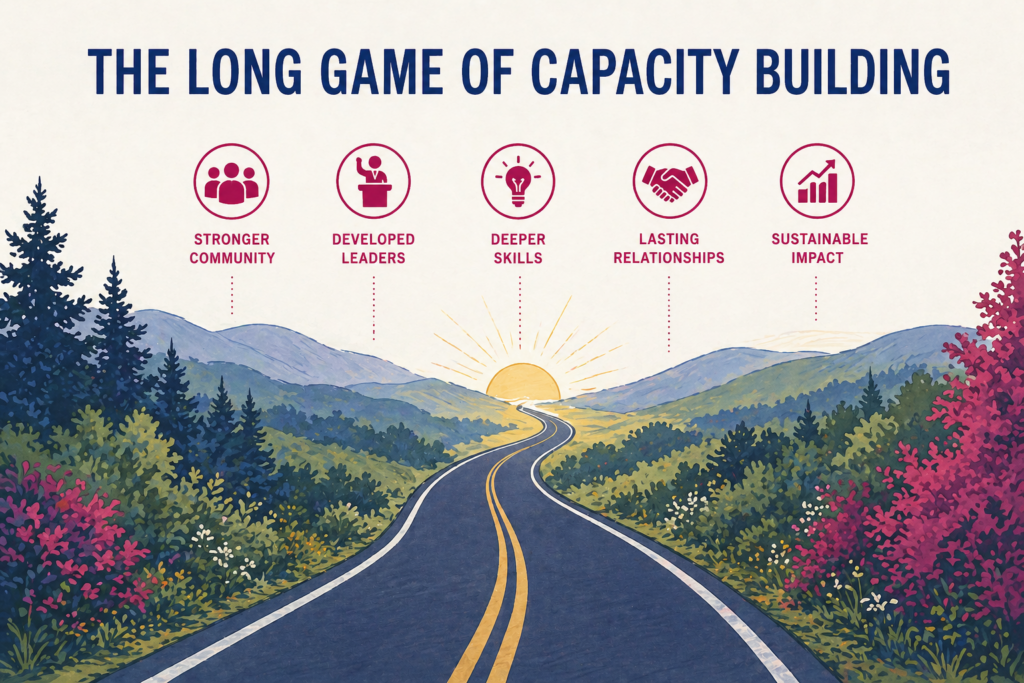
Movements don’t fail because people don’t care. They fail because people aren’t supported to stay.
Do what matters most. Shift your focus from short-term activity to long-term strength.
In The Happy Activist, I provide tools to help activists build activism that protects their energy while increasing their effectiveness. To build activism that strengthens them rather than drains them.
FAQs
Capacity building for advocates is the process of developing skills, leadership, relationships, and strategic understanding so people stay engaged in a movement over time rather than participating once and leaving.
Capacity building reduces burnout by creating supportive systems, encouraging sustainable pacing, and helping people grow their skills and confidence instead of feeling overwhelmed or undervalued.
Mobilizing focuses on getting large numbers of people to take action quickly. Organizing focuses on building relationships and leadership to keep people involved and contributing over time.
Retention allows movements to build knowledge, trust, and momentum. When people stay and grow, movements become stronger instead of constantly starting over.
It includes mentoring, leadership development, connecting tasks to strategy, creating community, and helping people take on increasing responsibility over time.
In nonprofit organizations, capacity building refers to strengthening the people, systems, and leadership needed to sustain and grow impact over time. For advocacy groups, this often focuses on developing volunteers into long-term leaders.
NEXT STEP
Ready to start the 5-Step Activism Path?
If this post helped you think differently about activism, the 5-Step Activism Path can help you turn that insight into a clear next step. Start with the full path and choose the section that fits where you are now.
Thanks for reading all the way to the end!
If you want activism that is both effective and sustainable, the next step is to look at how your own approach aligns with the 5-Step Activism Path.
If you want to dive deeper into capacity building, here are resources to support you.
- Understanding volunteer retention in a complex, community‐centred intervention: A mixed methods study in Ontario, Canada. This Gaber et al. (2022) research study shows that volunteers are more likely to stay engaged when programs provide clear roles, meaningful relationships, and ongoing support. In short, sustainable capacity is built by investing in people, not just in processes.
- Mental Health in the Workplace: How to Maximize Corporate Wellness
- How Employees Can Make a Difference for Mental Health in the Workplace


