How to Find the Cause Closest to Your Heart
Learn how to find your cause, the one that matters most to you. Concentrate your efforts for more focus and better results.

Why Finding Your Cause Matters
When you want to make a difference, it is easy to feel pulled toward every problem at once. Many people jump into activism without planning, resulting in a high activism dropout rate.
Sustainable activism begins with focus. Take the time to find your cause. Selecting the cause that you care about most doesn’t mean you don’t care about other issues. It means you’ll be an impacful and engaged activist.
How to Find Your Cause: An Overview
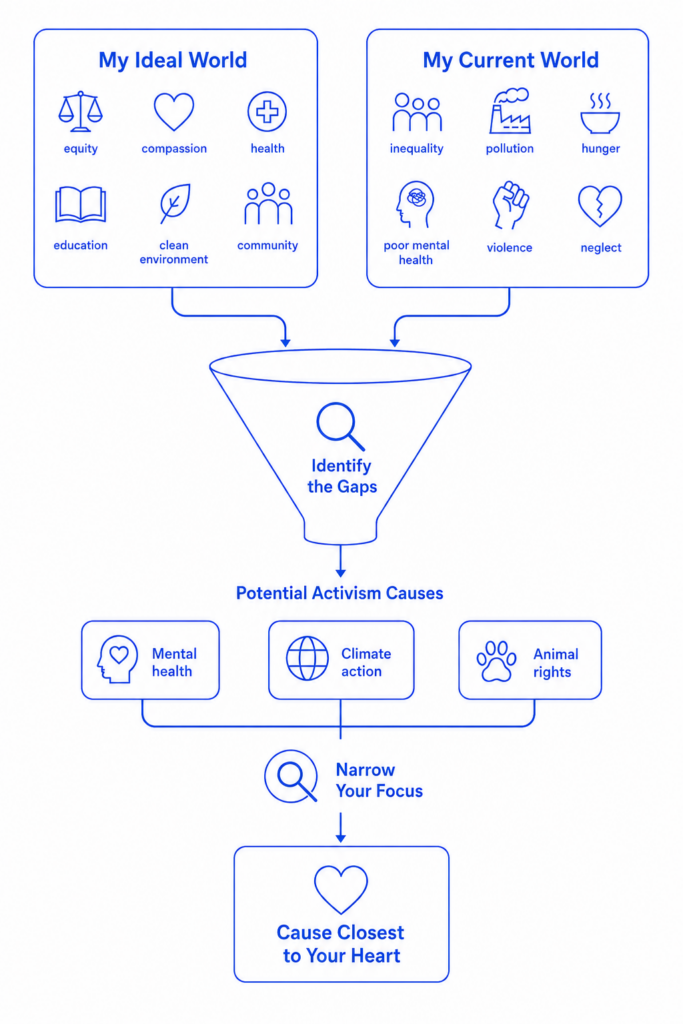
Finding your cause begins by comparing two things: the world you want to help create and the world you see around you now.
The gap between those two worlds can point you toward issues that matter deeply to you. From there, you can narrow your focus to a cause that feels meaningful, sustainable, and connected to your values.
How to Find Your Cause, Step by Step
Step 1: Imagine Your Ideal Life
Before choosing a cause, think about the kind of life you want for yourself, your loved ones, and the people in your community.
This is not selfish. Your own hopes, frustrations, and longings can point toward the cause you want to impact.
Your Values
Align your values with action to maximize your life satisfaction and resilience. Find your passion and make a difference in a way that honors your values.
Your Roles
We can only manage 5 roles effectively. What are your roles? Being clear about your top 5 roles means you can allocate your precious time and energy to what is most important, and fit activism into your ideal life.
Your Change
Examine the ways you’ve made change.
What causes have you supported? What skills did you use? Where did you make donations?
Life Lessons
Learn from your life lessons. What have they taught you? What experiences have shaped your worldview? Learn from those experiences to guide your ideal life.
Example: James Creates a Life Vision
James wants to give back to his community but finds himself stretched thin. He decides to step back and focus on the one cause that means the most to him. He creates a vision of his ideal life.
Roles: My 5 roles are student, son, partner, employee, and community advocate.
My Values: responsibility, family, capability, wisdom, and contentment.
Ways I Made Change: I am a college student working part-time to pay my tuition. I don’t have much time or treasure, but I continue a high school project of volunteering at the local food pantry. At times in my childhood, my family didn’t have enough food and had to rely on the food pantry. So, I prioritize a bit of my limited time to give back.
Life Lessons: I haven’t made many life choices yet, but when I reflect on what I would do differently, I remember growing up without enough food, and I feel ashamed that I hid that from my friends. There shouldn’t be a stigma associated with getting help when you need it, and I wish I had been open about our struggles so others would be aware of the issue. Also, my friends may have been more open with me if they were struggling.
James’ Life Vision: “I enjoy a life with family and friends and feel a sense of contentment. I have a profession that makes me want to go to work each day. I focus on my cause and give back to my community. Continuing to learn and grow is important.”
Step 2: Compare Your Ideal World to Your Current World
The gap between the world you see and the world you wish to see can point you toward toward the cause closest to your heart.
Your Ideal World
What does your ideal world look like? What do you wish for your community, the country, or the world?
Describe the kind of world you would create. Be clear about the change you wish to see in the world.
The Current World
Now reflect on the state of your community, the country, or the world. Notice the issues that grab your attention. What problems make you think, “Someone should do something about this”?
Who or what do I feel protective of?
The Gaps
Compare your ideal world to your current world. Where are the gaps? Which gaps resonate with you the most? Are you drawn toward a particular need or cause? Try to list at least three gaps. These are candidates for the cause closest to your heart.
Example: James Finds the Gaps
In my ideal world, people look out for each other, so everyone has their basic needs met. A college education is free. Scientists have solved the climate change crisis, so the environment is healthy. Freedom of religion (and from religion) is accepted freely, and no one tries to exert their religious principles into other people’s lives. There is world peace.
In my current world, I see much inequity – racial, gender, orientation, income, and health. Greed for money and power seems to be increasing, causing the gap between the social classes to widen. The lack of progress on climate change alarms me and makes me wonder whether I should have children. Educational standards are dropping, and college is out of reach for many people.
Bridging the gap: I am inspired by the people in my community who tirelessly provide for those in need. I feel angry about the lack of action on the climate crisis. It breaks my heart when children don’t have essential resources such as food, healthcare, and education.
James identified his top three passions:
- Providing resources for children and families.
- Climate change activism.
- Working to make education more accessible.
Step 3: Narrow Your Potential Activism Causes
It is time to narrow your potential activism causes to the one closest to your heart.
Sometimes, the cause closest to your heart reveals itself through strong emotional reactions. Emotional triggers often point to areas where you feel a deep connection or responsibility.
Narrowing your focus allows you to become exceptional at the cause you care about most. Instead of spreading yourself thin across multiple issues, you can channel your energy into the one cause that aligns perfectly with your passion, skills, and motivation.
What inspires you and makes you want to act?
What makes you angry? Tap into that motivation.
Who or what do you love that needs your help?
Example: James Finds the Cause Closest to his Heart
When James considers his reflections, he realizes that his childhood experiences of lack of consistent, healthy food greatly impacted him. He doesn’t want any child to go without necessary resources, and he also greatly admires the people who supported his family when they were in need. When he thinks about how he allots his limited free time to help the food pantry and how much he enjoys giving back to this cause, he knows this is the cause closest to his heart.
Want Help Finding Your Cause?
Take the free course Find the Cause Closest to Your Heart and begin focusing your activism around the issue that matters most to you.

Want the Full Guided Process?

Start with The Happy Activist
The Happy Activist introduces the 5-Step Activism Path and offers a research-based approach to meaningful, sustainable activism.
Designed for both new and experienced activists, it combines practical guidance, real-world examples, and evidence-based strategies to help you create change without burning out.

Add the Companion Workbook
The 5-Step Activism Path Workbook includes worksheets, reflection prompts, and quizzes to help you clarify your values, identify possible causes, and choose a meaningful place to begin.
Featured Articles
Start with a few practical articles and guides selected to help you take the next step.


What's Next?
Go to Step 2: Take Stock of the Gifts You Bring to Activism
Now that you have started narrowing your cause, the next step is to identify the strengths, skills, and experiences you bring to the work.
Resources for making a difference.
Find a path that fits your life.
Find a path that fits your life.
