

- Happy Activism: A Sustainable Way to Create Change Without Burnout - February 9, 2026
- The Meaning of Critical Thinking: A Key Skill for Navigating Today’s Information Landscape - November 3, 2025
- Grandparents Can Develop Activist Grandchildren - September 29, 2025
Last Updated on February 8, 2026
In this post, you will learn about the different types of social change agents. Explore which type you most resemble and learn how to get started in activism with the 5-Step Activism Path, developed by Dr. Terri Lyon, a licensed psychologist and professor.
I teach at Walden University, whose mission statement includes social change. Neat, right? All student work incorporates an element of social change, such as being a change agent in social work or becoming a social entrepreneur. And Walden research focuses on the question, “What are the agents of social change?”
In addition to the focus on making the world a better place, Walden is a Certified B Corporation. This certification is for businesses that balance profit with purpose.
Interestingly, Walden was one of the first distance-learning schools, back in the snail-mail days. The founders wished to equip students to solve society’s problems. Their motto: Education For Good.
Different Ways To Make Change
Activism and Volunteering

I define activism as influencing people to change their behavior. Instead of just educating someone about an issue, you encourage them to take action.
Volunteering is like activism in that it involves people spending their time in service of others. For example, cleaning litter from a stream is volunteering; advocating to change littering laws is activism.
Activism and social change are similar, so I use both terms.
Social Entrepreneurs
Social entrepreneurs run businesses that have a profit motive, like Walden, but care about fairness and sustainability. Both social change and social entrepreneurship make change, but one has a profit component. Social entrepreneurship is a term that seems to encompass the idea of a B Corporation.
Is there a role for a for-profit university in social change? Based on my experience at Walden, the answer is yes. Another university, Ashoka, also trains students to be changemakers.
“We bring together social entrepreneurs, educators, businesses, parents & youth to support a world in which everyone is equipped & empowered to be a changemaker.”
It appears there are many ways individuals and groups can be problem-solvers for society’s good as a whole, rather than for what benefits them.
What are the Agents of Social Change?
As a part of its social change mission, my university performs research on social change. In 2013, they published a social change impact report.
On my activism path, I explore the motivations behind activism and encourage you to examine your background and experiences. Were you raised by activists or in a family that did not volunteer? Perhaps your motivation isn’t about morals but instead about learning new things.
Types of Social Change Agents
Here are the types of social change agents from the research.
Ultracommitted Change-Makers
First, Ultracommitted Change-Makers are dedicated, motivated, and make change a part of living their values. They were usually raised in a family that focused on activism.
Faith-Inspired Givers
In the second group, religion influences Faith-Inspired Givers. Their parents are likely to be inspired by faith as well. A moral responsibility to give back drives them.
Socially Conscious Consumers
Third are Socially Conscious Consumers. They seek the sustainability of products and services. They also expect vendors to be fair and responsible employers. When making purchasing decisions, they care about environmental and social justice issues.
Purposeful Participants
Fourth are Purposeful Participants. They tie their activism to external motivators, such as work initiatives and gaining new skills.
Casual Contributors
The fifth group, Casual Contributors, may see issues in their community but may not always act to change them. Many are older adults without children.
Social Change Spectators
Finally, Social Change Spectators likely came from families that did not emphasize activism. They tend to see little relationship between their actions and change.
Where do you fit in as a social agent?
[Learn more about how to find your passion and change the world.]
Global Differences
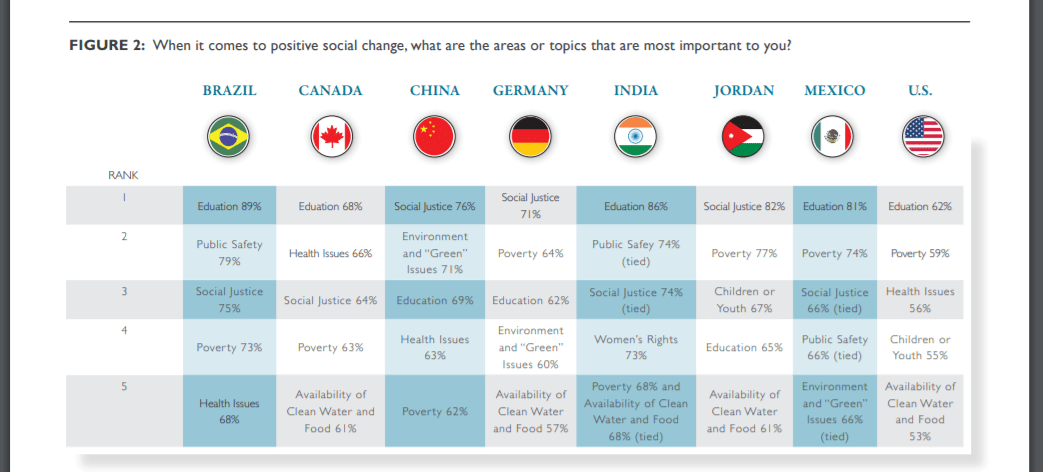
One of the interesting parts of the survey results is how people from various countries differ on each question. For example, here are the responses to the question, “When it comes to positive social change, what are the areas or topics that are most important to you?”
The Student Activist

The Ashoka organization believes that parents should be teaching change-making skills very early. They can develop skills to recognize problems and help solve them. And to know when they are the right person to step up. The parents of Ultracommitted Changemakers and Faith-Inspired Givers likely had parents who made this a part of their children’s lives.
Over the years, I’ve been impressed by students’ dedication to incorporating social change into their degree programs, particularly being a change agent in social work or a social entrepreneur. Many students enter school as social change agents. And others use their program to gain experience and set a direction for future social change work.

One of my students, a Buddhist Monk, pointed out that change can be spiritual, too:
“I define Spiritual Change as the ability to experience inner peace and fulfillment independent of one’s outer situations. When this happens, one becomes all the more empowered to bring about Social Change. The Buddha, Dr. Martin Luther King and Mahatma Gandhi are all examples of leaders whose initiatives for social change were primarily sourced in Spiritual change.”
What an interesting point. To be sure, religion and faith inspire social change calling for many people.
You as a Changemaker
Your background and family experiences may have influenced whether you have been a changemaker in the past. Also, your time, resources, and support influence how much changemaking can be a part of your life.
When you consider your ideal life, does your activism role look different from your quiz results? Perhaps consider incorporating activism into your life in a different way.
“Creating positive social change can occur on an individual, group, community, regional, national, and world level. We may think of social change in great world leaders or events. Still, social change begins with one individual committed to helping correct a social problem.” – Walden University
Learn more about Getting Started in Activism.
- Focus your passion and find the cause closest to your heart among the myriad of causes.
- Match your skills with the type of activism work that best suits you.
- Find an activism opportunity that works for your life.
- Determine if your social justice work truly makes an impact.
- Stay motivated in your activism for the long-term.
It’s not too late to start. You can be a changemaker.
Identifying your social change agent type helps you see how your unique skills and motivation translate into sustainable social change. My book, The Happy Activist, is an evidence-based guide for designing activism that fits your life.
Frequently Asked Questions About Social Change Agents
Identifying your social change agent type helps you match your unique skills to the cause closest to your heart. Statistics show that between 60% and 98% of people drop out of social change efforts, often because they end up doing work that does not align with their skills or motivation.
Finding your social change agent type primarily addresses Step 2 (Inventory your skills) and Step 3 (Choose your Activism Method). Once you understand your social change agent type, you can customize your activism for better effectiveness and motivation.
Summary
I’ve designed this post to help you find exactly where you fit in the world of social change. By exploring different archetypes of social change agents, you can better understand how my 5-Step Activism Path makes activism feel both accessible and deeply sustainable. My goal is to help you match your natural talents and unique motivations to the causes you care about, ensuring your changemaking is effective and joyful rather than overwhelming.
READ NEXT
How To Master Social Change Definitions: Try This Sure-Fire Guide
From Awareness to Action: Empowering People to Make a Difference in Social Justice
Change agents in social work can learn more about Walden University’s roots in social change:
Learn How to Craft Excellent Social Change Education






Pingback: Make the World a Better Place