- Happy Activism: A Sustainable Way to Create Change Without Burnout - February 9, 2026
- The Meaning of Critical Thinking: A Key Skill for Navigating Today’s Information Landscape - November 3, 2025
- Grandparents Can Develop Activist Grandchildren - September 29, 2025
Last Updated on March 18, 2026
On March 18, 2026, Dolores Huerta issued a statement about sexual abuse at the hands of Cesar Chavez. I stand by her and mourn the impact of the abuse on her and her family. This is her statement.
“I am nearly 96 years old, and for the last 60 years have kept a secret because I believed that exposing the truth would hurt the farmworker movement I have spent my entire life fighting for.
“I have encouraged people to always use their voice. Following the New York Times’ multi-year investigation into sexual misconduct by Cesar Chavez, I can no longer stay silent and must share my own experiences.
“As a young mother in the 1960s, I experienced two separate sexual encounters with Cesar. The first time I was manipulated and pressured into having sex with him, and I didn’t feel I could say no because he was someone that I admired, my boss and the leader of the movement I had already devoted years of my life to. The second time I was forced, against my will, and in an environment where I felt trapped.
“I had experienced abuse and sexual violence before, and I convinced myself these were incidents that I had to endure alone and in secret. Both sexual encounters with Cesar led to pregnancies. I chose to keep my pregnancies secret and, after the children were born, I arranged for them to be raised by other families that could give them stable lives.
“Over the years, I have been fortunate to develop a deep relationship with these children, who are now close to my other children, their siblings. But even then, no one knew the full truth about how they were conceived until just a few weeks ago.
“I carried this secret for as long as I did because building the movement and securing farmworker rights was my life’s work. The formation of a union was the only vehicle to accomplish and secure those rights and I wasn’t going to let Cesar or anyone else get in the way. I channeled everything I had into advocating on behalf of millions of farmworkers and others who were suffering and deserved equal rights.
“I have never identified myself as a victim, but I now understand that I am a survivor—of violence, of sexual abuse, of domineering men who saw me, and other women, as property, or things to control
“I am telling my story because the New York Times has indicated that I was not the only one—there were others. Women are coming forward, sharing that they were sexually abused and assaulted by Cesar when they were girls and teenagers.
“The knowledge that he hurt young girls sickens me. My heart aches for everyone who suffered alone and in silence for years. There are no words strong enough to condemn those deplorable actions that he did. Cesar’s actions do not reflect the values of our community and our movement.
“The farmworker movement has always been bigger and far more important than any one individual. Cesar’s actions do not diminish the permanent improvements achieved for farmworkers with the help of thousands of people. We must continue to engage and support our community, which needs advocacy and activism now more than ever.
“I will continue my commitments to workers, as well as my commitment to women’s rights, to make sure we have a voice and that our communities are treated with dignity and given the equity that they have so long been denied.
“I have kept this secret long enough. My silence ends here.
“If you are a survivor or if you have been impacted by any type of sexual violence, please visit the Dolores Huerta Foundation website, where you will find a list of resources for support.”
Huerta Was an Equal Partner of Chavez

Dolores Huerta was raised in California by a single mom who was active in community work. Police brutality against Mexicans and blacks was the issue that tugged at Huerta’s heart. Community organizer Fred Ross involved her in the Community Service Organization, and she was drafting legislation in her early 20s. Ross introduced her to Cesar Chávez; together they worked on organizing a farmworkers union.
Huerta was a young mother but she embraced the challenge, describing it as a calling. Her early experiences seeing police brutality and the obviously terrible conditions for farmworkers inspired her: low pay, terrible housing, lack of access to clean water and bathrooms, and long work shifts with no breaks.
Having a woman on the Board of the Union and on the picket line meant women were welcome as part of protests, and their voices could be heard. But she was also a target for holding a traditionally male position.
It took years and a variety of initiatives, but they succeeded in creating the National Farm Workers Association. For workers, that meant better working conditions, insurance, a credit union, and a voice.
[Inspired by their results? Get started in activism.]
She Coined a Famous Phrase
Huerta’s work goes beyond organizing the Farmworkers because, as marginalized people, their organizing inspired other marginalized communities.
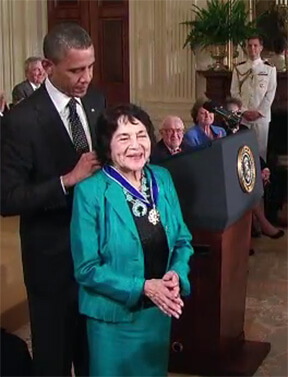
When Obama used the slogan “Yes, we can,” he borrowed it from Huerta, who coined the phrase “Sí Se Puede” in Spanish years earlier. When he awarded her the Presidential Medal of Freedom, he apologized to her for not giving her proper credit.
After Chávez died, members did not elect Huerta president of the union board. She didn’t complain about it because she was more concerned about the work, and she felt the person elected president would do a good job. Eventually, though, she disagreed with the union about her goal of returning to community organizing, so she left.
Huerta’s Work Continues
Huerta created the Dolores Huerta Foundation to teach others leadership skills and community organizing.
Later in life, she says she regretted not advocating more for herself and her accomplishments and encourages women and girls to avoid that trap.
“We were having elections and Cesar [Chavez] was running the meeting, he stepped down from the dais and came up to me. He said, “Who’s going to nominate you for vice president?” And I said, “Oh, I don’t have to be on the board. I just want to serve all the women out there.” How many of us have thought that way? And he said, “You’re crazy.”
So I did — I grabbed somebody to nominate me. But if Cesar hadn’t told me to, I wouldn’t have thought about it. And I think that’s a problem with us as women — we don’t think we need to be in the power structure, that we need to be on those boards where decisions are being made. Sometimes we think well, I’m not really prepared to take that position or that role. But I say [to women out there]: Just do it like the guys do it — pretend that you know. And then you learn on the job.” – Dolores Huerta
Dolores Huerta’s accomplishments include negotiating the first contract for the farmworkers, lobbying, and advocating for Latina female candidates. She is still advocating for others. Her current cause: expanding end-of-care options.
[Please share this post with a friend who wants to make a difference in the world.]
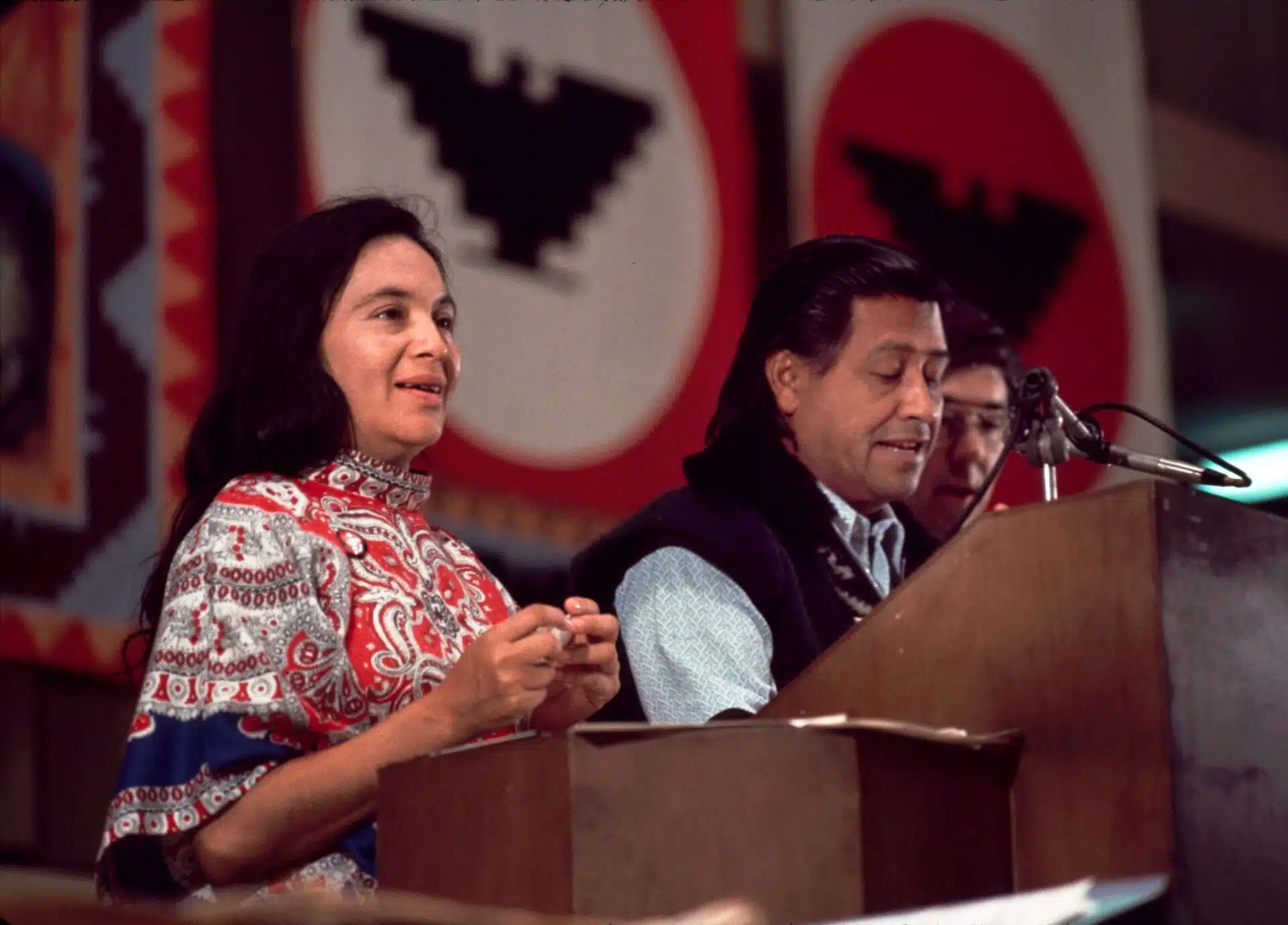
Featured Image: Bob Fitch photography archive, © Stanford University Libraries
READ NEXT
Dolores “One of the most important, yet least known activists of our time, Dolores Huerta was an equal partner in founding the first farmworkers union with César Chávez. Tirelessly leading the fight for racial and labor justice, Huerta evolved into one of the most defiant feminists of the 20th century — and she continues the fight to this day, in her late 80s. With unprecedented access to this intensely private mother of 11, Peter Bratt’s film Dolores chronicles Huerta’s life from her childhood in Stockton, California to her early years with the United Farm Workers, from her work with the headline-making grape boycott launched in 1965 to her role in the feminist movement of the ’70s, to her continued work as a fearless activist.”
Browse more examples of artistic activism.
Browse more activist profiles.





As you always seem to, you’ve written about something that matters. I remember Huerta’s name from the 60s/70s but never knew much about her. Thanks.
Thanks for stopping by, Ellen! I’m inspired by her passion and persistence.